
(Please note that this post is not sponsored or associated with an affiliated partnership with Peloton. I am a member who pays for my own memberships, and I am simply sharing my current routine with specific examples of how you can tailor group fitness programming for maximum results. I hope this helps!)
As a certified personal trainer who knows how to program workouts that create results, I get this question more than you’d think:
Why do I pay for workouts when I could just program my own?
And honestly, I get it. On paper, it probably doesn’t make much sense.
I’ve spent over a decade learning the science behind exercise fitness, designing workouts for clients and for myself. I’ve created countless workout graphics and templates to share here and on social media, and I search the archives to repeat them from time to time.
I know how to build strength programs, how to structure progressive overload, and how to periodize training so you actually see results. I could walk into a gym right now and put together a really solid plan without thinking twice.
And I’ve done that before … for years.
But I’m not in that season right now (and this post is all about why!).
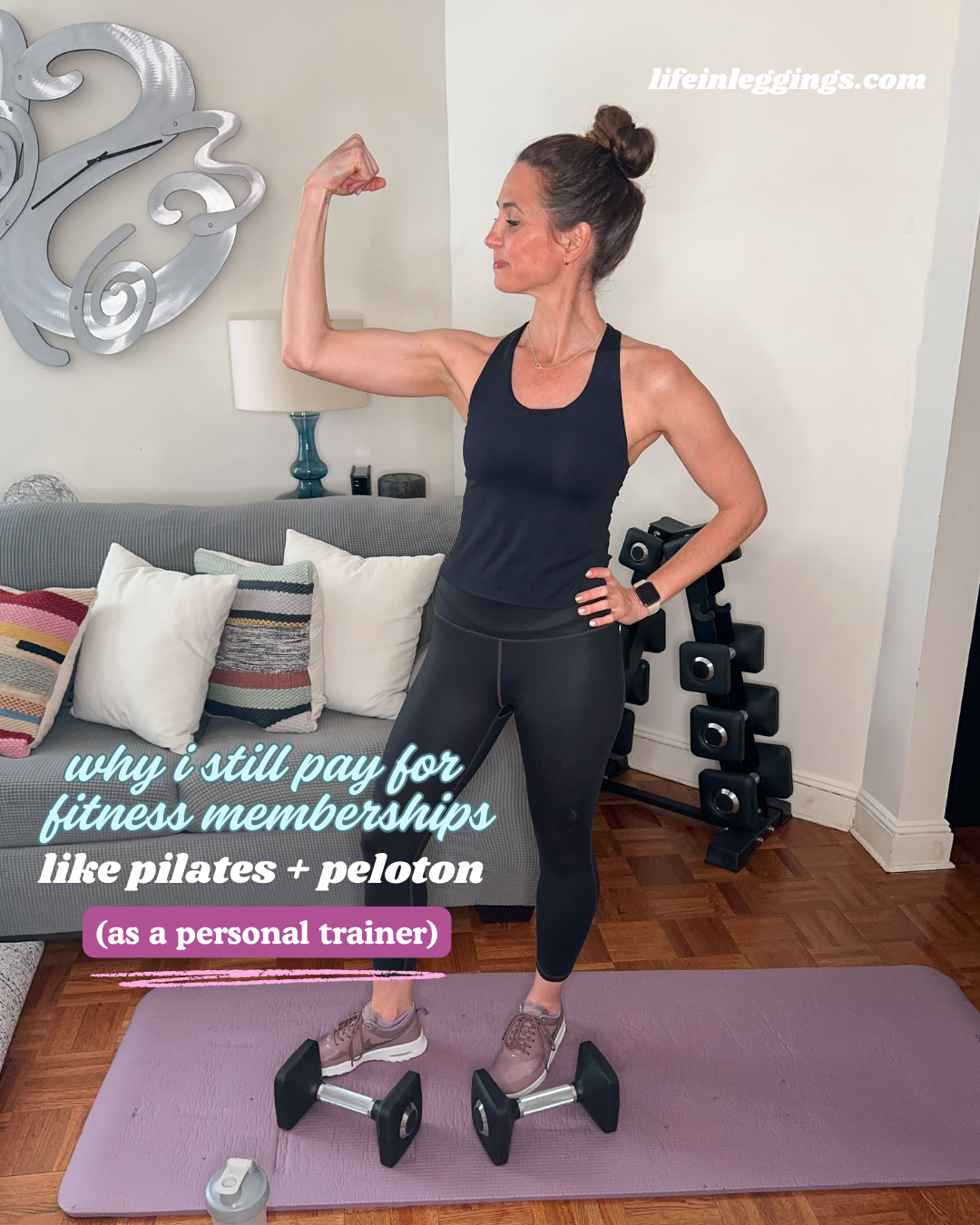
These days, I’m juggling a lot more than just my own training plan. Between motherhood (and lots of solo parenting), content creation, and helping support my husband’s business, I spend most of my days in “decision mode.” I’m constantly planning, organizing, thinking ahead, pivoting and switching gears.
So when it comes time to work out, I really don’t want another thing to figure out.
While I’m very able to lead my workouts on my own (and yes, I still train clients in the city and program those sessions!), I’m in a season of needing to work smarter, not harder for myself.
I don’t want to think or motivate myself during my own workouts – I simply want to show up, press play, and be told what to do for 30–45 minutes. And I’ve realized this is completely normal and okay!
That mental shift alone has changed everything for me, so I hope this message helps you if you’re in a similar spot or feeling overwhelmed by staying on top of workouts and not quite sure what to try next.
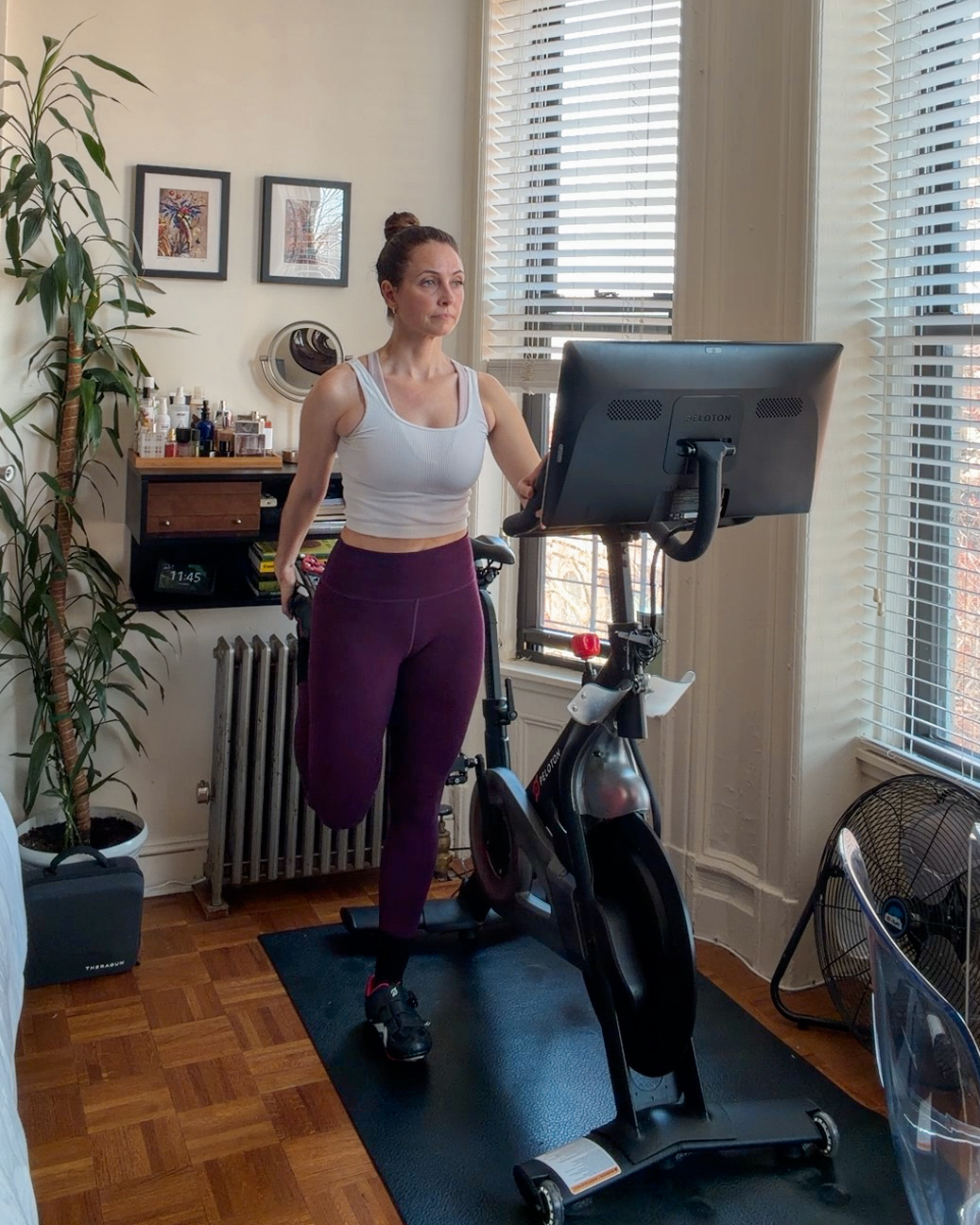
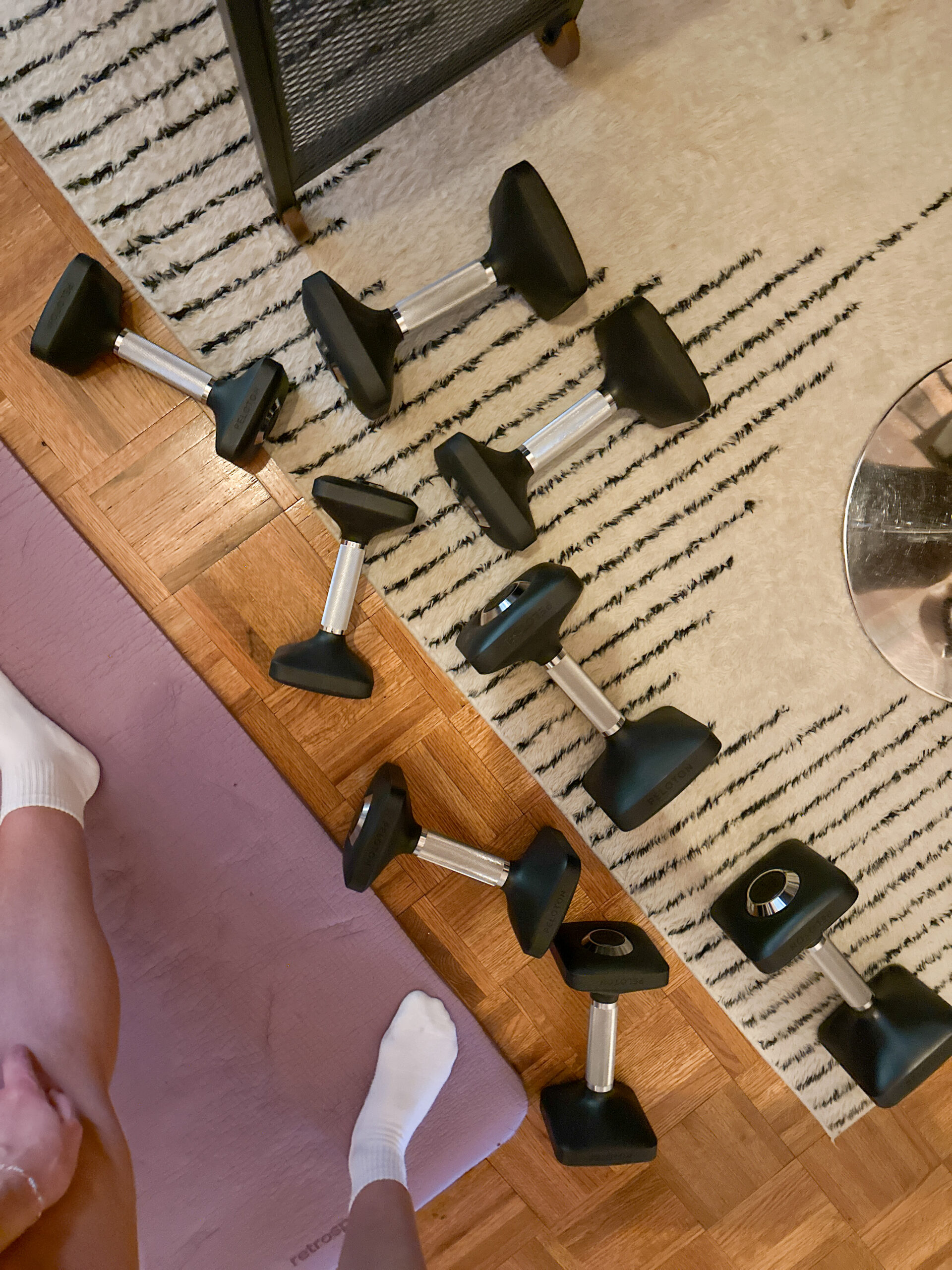
Lately, most of my strength training has been at home with dumbbells and a yoga mat with weight sets ranging anywhere from 3-30 pounds. I subscribe to Peloton and have been following programs with their coaches over the past year. We have the original Peloton bike, and I typically complete a 20-45 minute ride about 1-2 times per week.
(I still enjoy long walks and jogs outside, but I wouldn’t say that I *love* running anymore. Because of this, my preferred method of intentional cardio has naturally changed from running to sessions on the bike!)
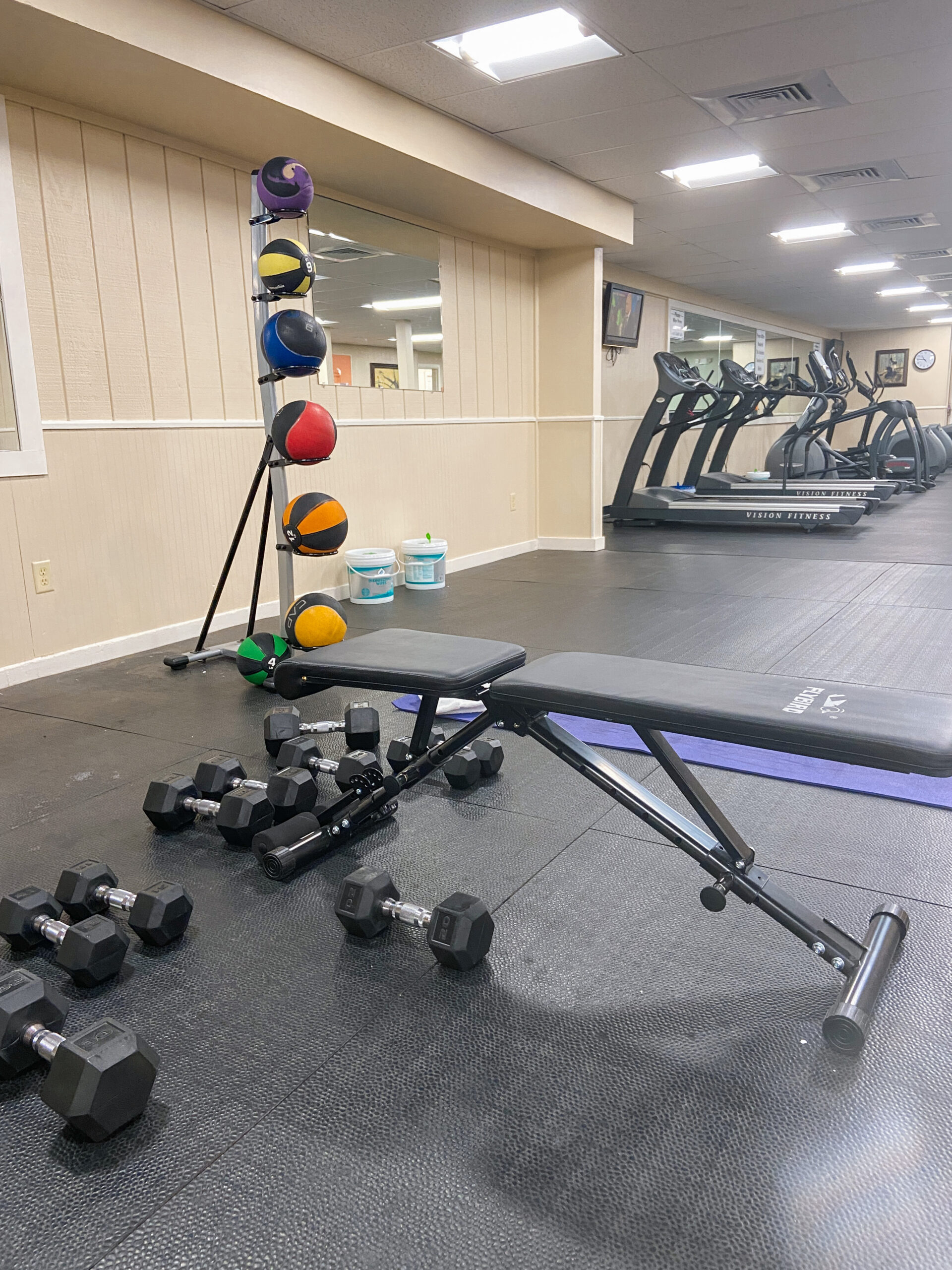
I regularly checked into a local gym to use the weight machines until about six months ago, but I paused that membership once I realized that I barely wanted to use it. Eventually I found I wasn’t excited to go anymore. Between crowded workout areas and constantly adjusting my plans around equipment availability, my workouts at home became more enjoyable and more realistic for this season of life.
So I decided to put my money elsewhere and haven’t regretted it at all!
While any movement is better than no movement, many of us also want our workouts to produce measurable results. That’s where having some sort of plan in your fitness routine becomes important.
Random workouts feel fun in the moment, but they’re not always the most effective if your goal is real strength that actually builds and progresses over time.
If you want to see maximum results in your workouts, you need more structured programs (ideally progressive overload) – workouts that actually build on each other over time instead of just randomly picking something different every day.
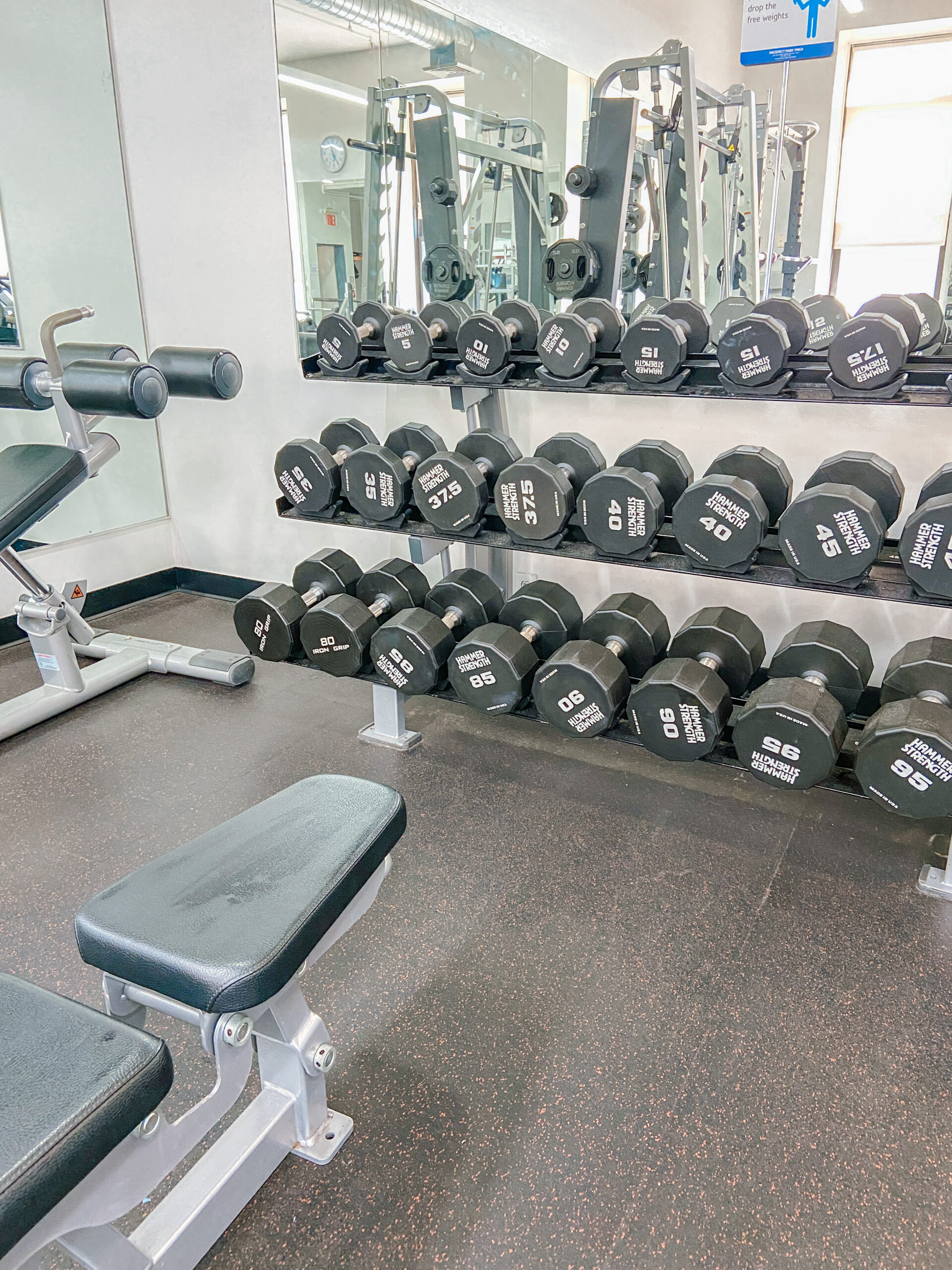
This means that you’ll repeat a series of workouts for no less than 4 weeks, and ideally 6-8 weeks. In a perfect world, you want to repeat the same 2-4 strength workouts every week and tweak the following along the way:
- Increasing weight
- Adding repetitions
- Increasing sets
- Slowing down the tempo
- Reducing rest periods
- Improving movement quality and form
This is exactly how personal trainers program templates specifically catered to YOU, and I was beyond thrilled when I saw that Peloton rolled this type of programming out in 2023. They also offer a series of programs that repeat workouts week after week, and I have tried more than a handful of them, some more than once.
Knowing my habits, I always pick a program that includes 2-3 strength workouts that are 30 minutes or less, and this allows me to show up consistently and include other cardio and low-impact formats along the way, too. It’s my sweet and happy spot.
What actually works is repetition with progression by doing similar movements over a few weeks, gradually increasing weight, improving form, and adding challenge. It really is the foundation of getting stronger.
So when Peloton started offering that in a more intentional way, I was all in on transitioning into a season of letting go of what I thought I “should” be doing and embracing what I actually enjoyed doing. It made me realize I didn’t need a traditional gym membership right now, at least for a little while.
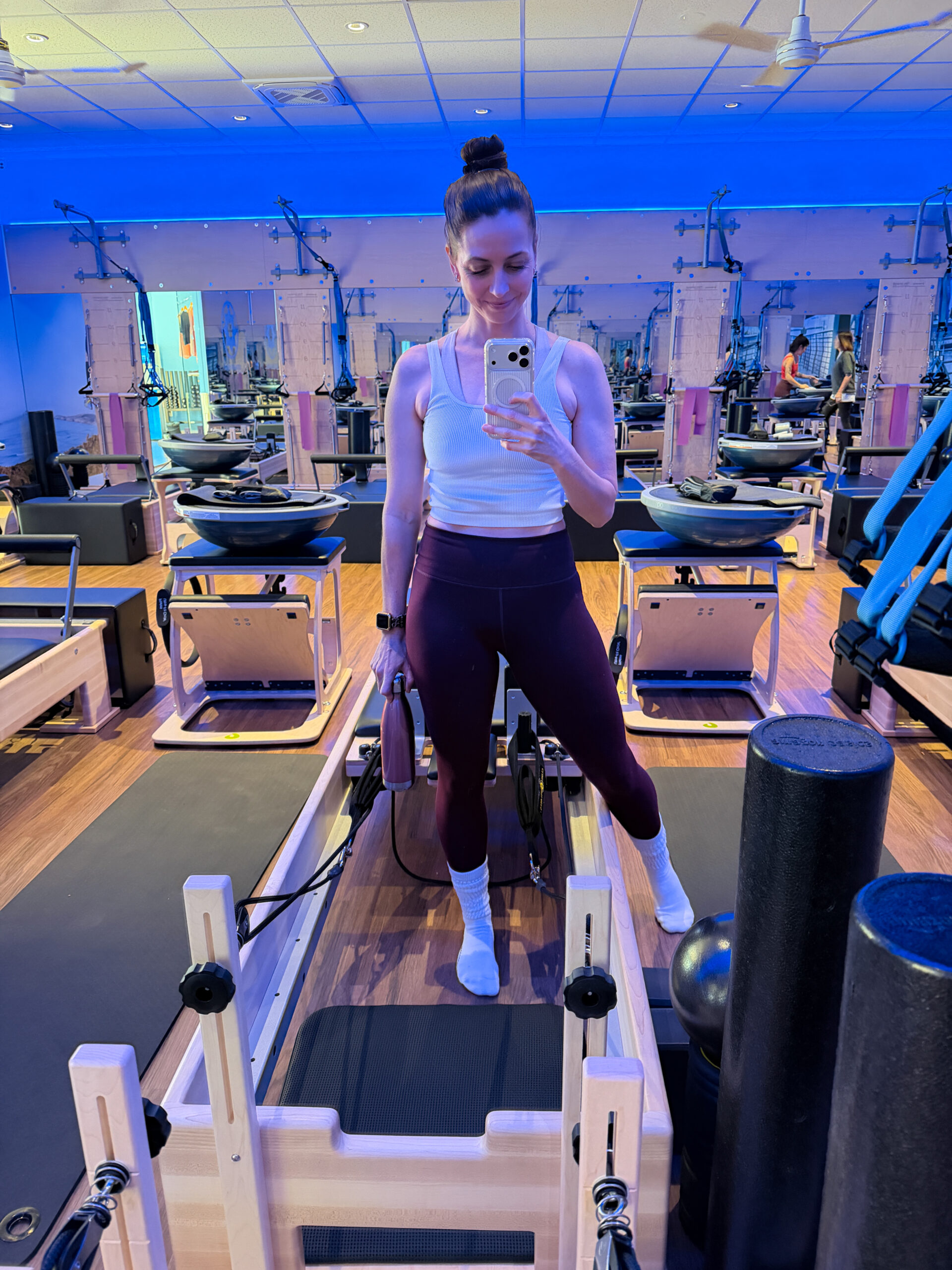
Instead, I focused that energy (and money) into something I’ve really been loving and always show up for: reformer Pilates.
I go twice a week, and it’s become such a nice complement to my strength work. It’s slower, more controlled, and completely different from lifting or cardio. It challenges my core in ways I don’t always get from other workouts, and it feels like a reset for my body and my mind.
It’s not about intensity, it’s about balance.
And that’s really what my routine looks like right now – it’s not perfect, but it features a few structured strength sessions through Peloton each week, some cardio mixed in, two Pilates classes, and at least one or two full rest days. Nothing extreme, nothing overly complicated, just something I can actually stick to!
That’s the piece I keep coming back to, both as a coach and as a human living in this season of life and motherhood: the best workout plan is always the one you’ll actually follow.
Not the one that looks perfect on paper. Not the one you feel like you “should” be doing. And definitely not the one that requires so much planning that you end up skipping it altogether.
Consistency always wins, and consistency usually comes from enjoyment.
If you hate biking or swimming, you probably don’t need to force yourself into training for a tri-athlon. If you love group fitness, lean into that energy. If home workouts make your life easier, that counts just as much as a gym membership ever could.
There’s no single right way to stay active, and for me right now, it looks like turning my brain off, following a fun and motivating coach, and letting someone else lead the way.
Will this be the answer forever? Probably not. But it’s what I’ve been enjoying and sticking to consistently for over six months, and I don’t see it changing any time soon.
Fitness doesn’t have to look the same in every season of life. Right now, my flexible routine works because it fits my life … not because it’s perfect.
Thanks for reading today, and I hope this helps you try something new and go into your own fitness routine with a more realistic approach!
What does your fitness routine look like these days?
Are you a fan of group fitness classes or membership subscriptions?
xo, Heather


Even as a personal trainer, I pay for fitness memberships because they provide access to specialized equipment, a motivating environment, and professional communities. They also help me stay accountable to my own fitness goals while continuing to learn from different training methods.
I really enjoyed reading this! I completely agree that having the right environment and staying consistent makes a huge difference. I’ve been focusing more on my fitness lately, and small lifestyle changes have helped me stay motivated. I also recently purchased an elegant brown waist corset and I was pleasantly surprised by how comfortable it is. It gives my outfits a polished look while boosting my confidence, so it feels like a nice blend of fashion and fitness. Thanks for sharing such an honest and relatable post!
I completely relate to decision fatigue when it comes to planning my own workouts after a long day. Have you found that sticking to a structured Peloton program gives you enough variety without feeling repetitive fnf ?
Yes! I generally complete the same program for 4-6 weeks, then start a new one. Sometimes I’ll have a buffer week or two where I’m choosing my own workouts (but do similar splits to work different muscles each workout), but I generally start a new one after traveling or taking a quick break.
I like the honesty behind this perspective because being a personal trainer doesn’t automatically mean you have to do every workout at home or rely entirely on your own expertise; sometimes paying for a fitness membership provides structure, equipment, variety, or simply a change of environment that helps keep training enjoyable. I especially agree that knowing what to do and actually creating the motivation and routine to do it are two different things. Personally, I think the value of a gym membership is often as much about consistency and environment as it is about access to equipment. Keeping workout plans, training notes, and downloaded resources organized can help too, with ZArchiver APK being useful for managing archived files on Android. What’s the biggest reason you continue paying for a fitness membership?
zarchiver-apk recently posted…ZArchiver for PC: Windows Download, Setup & Alternatives
-Hello viewers, am here to share my amazing testimony with you all about a great spell caster called Dr Ogaga I have never seen a powerful spell caster like him before, I have been playing lotto for years now and I have never won any reasonable amount of money, I met Dr Ogaga online through a testimony I saw on line about a man who won $11,000,000 through Dr Ogagas help and i also decided to contact him to see if I could also be lucky, I contacted him and he assured me that he will help me win too and that he has helped a lot of people all over the world, at first I was a bit skeptical about it but I decided to give it a try anyways since I have nothing to loos, he instructed me on what I needed to do which I did without and stress at all and on the second day after the prayers he sent me some numbers and asked me to go and play them I quickly went to the store and play the number and the next result day I went to check, WOW I couldn’t believe my eye the exact numbers he gave me was the winning numbers that was on the machine that was how I became a millionaire just like that, I can never stop sharing this testimony for all to see, my friends if you happen to come across this post make sure you contact him too and be the next winner.
Email ogagaodia41 @ gmail. com
Whats>>App +1(365)350-5955.
I’ve never seen or heard of Native Hindi lottery spell failing
I was convinced after using the numbers provided by Native Hindi solution when I told him I wanted to win the lottery because of the post I saw online about his winning numbers, he said he has helped a lot of people and I won’t be an exception to that, he put in work for me after I provided the necessary Information he requested from me, after then he gave me the numbers to play after 24 hours and directed me on how to play and when I should play them which I did, I won £5.4 million pounds, I’m excited that my dream has come through, Native Hindi solution is the best when it comes to winning the lottery with spell and prayers Email: hindinativee@yahoo.com OR What’s App: +1 718 717 8356 thank you.
My name is Darlene M, and I never imagined my life could change so fast. I was struggling with some unpaid bills and financial stress for years, and I was constantly wondering how people are able to win the lottery so big because I sometimes play the lottery but never won any big amount, I sought spiritual guidance from Chief Ade after I heard about him, how he has been helping people with the lottery winning numbers, and not long afterwards I won the $16,000,000 MILLION Lotto 6/49 Gold Ball jackpot with the numbers he gave me. That incredible win completely transformed my life. I was able to pay off all my debts, purchase a brand-new truck, and make sure my children had everything they needed to pursue their dreams. I also chose to share my good fortune by supporting local charities and helping families in need, because I know what it’s like to struggle. I’m sharing this to remind whosoever seeing this that hope can inspire people to keep believing, even during difficult times. Email: chiefadespellhome@gmail. com || Whats App +234 901 380 6328
My name is Darlene M, and I never imagined my life could change so fast. I was struggling with some unpaid bills and financial stress for years, and I was constantly wondering how people are able to win the lottery so big because I sometimes play the lottery but never won any big amount, I sought spiritual guidance from Chief Ade after I heard about him, how he has been helping people with the lottery winning numbers, and not long afterwards I won the $16,000,000 MILLION Lotto 6/49 Gold Ball jackpot with the numbers he gave me. That incredible win completely transformed my life. I was able to pay off all my debts, purchase a brand-new truck, and make sure my children had everything they needed to pursue their dreams. I also chose to share my good fortune by supporting local charities and helping families in need, because I know what it’s like to struggle. I’m sharing this to remind whosoever seeing this that hope can inspire people to keep believing, even during difficult times. Email : chiefadespellhome@gmail. com || Whats App +234 901 380 6328 .
Hello Internet Friends,
I’m so happy my husband is back! Thanks to Dr. Excellent for saving my marriage. My name is Heather Delaney. I married the love of my life Riley on 10/02/15 and we now have two beautiful girls Abby & Erin, who are conjoined twins, that were born 07/24/16. My husband left me and moved to be with another woman. I felt my life was over and my kids thought they would never see their father again. I tried to be strong just for the kids but I could not control the pains that tormented my heart, my heart was filled with sorrows and pains because I was really in love with my husband. I have tried many options but he did not come back, until I met a friend that directed me to Dr. Excellent spell caster, who helped me to bring back my husband after 11hours. My husband and I are living happily together again, This man is powerful, contact Dr. Excellent if you are going through any difficulty in life or having troubles in your marriage or relationship, he is capable of making things right for you. Here is his contact. Call/WhatsApp him at: +2348084273514 “Or email him at: Excellentspellcaster@gmail. com
Hello everyone am Gary Van I want to use this medium to appreciate a great spell caster called Dr Ogaga that transformed my life financially, I used to work as driver in a company and I always play lotto but I have never been lucky, then one day as I was glancing through the Internet I came across a testimony of a woman who won $600million through the help of a strong spell caster called Dr Ogaga after praying for her he gave her a lucky numbers to play and she won 600,000,000$ I also decided to try my luck I contacted the Dr Ogaga and he promise he was going to help me win too I didn’t actually believed 100% but on the second thought I decided to give it a try He instructed me on what I need to do which I did with no stress at all, then after two day he sent me some numbers and asked me to go and play them I went strait to the store and play the numbers then I went back to check when the results were out, behold my numbers came out as the winning numbers it was like a dream to me, even till now I still fined it difficult to believe that I am now a millionaire from being a driver to being a millionaire all thank to Dr Ogaga I will never forget your help, if you are out there and you also want to be a winner I will advice you to also contact Dr Ogaga and I promise you he will not disappoint you at all. Here are his contacts.
Email ogagaodia41@gmail. com
Whats>>App +1(365)350-5955.
My testimony on how I became a member of the Illuminati. Lord Felix helped me get my life back from the death stage. Discharged after about 2 years and six months. After being betrayed by so many members of the Illuminati. Over the years I was hopeless and financially on the ground. But one day while browsing the internet, I came across the post by the Great Member of the Illuminati Lord Felix and said that if you were one of the great Illuminati members, you can be famous, rich and successful in life. I contacted him and I explained everything to him and he recommended the registration used and I paid for the big member to get me started and I was initiated into the World Order of the Illuminati. After that, they gave me all the guidelines and let me know that after initiation new members will be rewarded with the sum of $2,000,000 in cash. With the help of Lord Felix. I was fully initiated as a full member of the Illuminati. My advice is that if you’ve tried a scammer before. It’s up to trying Lord Morgan. It’s your best chance to become what you want in your future life. Contact him by WhatsApp +2348168034022